3D MODELLING IN OIL & GAS ENGINEERING UAE: WHY IT IS ESSENTIAL IN 2026 AND WHAT YOUR PROJECT TEAM NEEDS TO KNOW
3D Modelling for Oil & Gas Engineering Projects in UAE — A 2026 Guide
There was a time — not very long ago — when a detailed engineering deliverable for a UAE oil and gas project consisted primarily of 2D drawings: plan views, elevations, isometrics, and GA drawings produced in AutoCAD or equivalent drafting software. That time has passed.
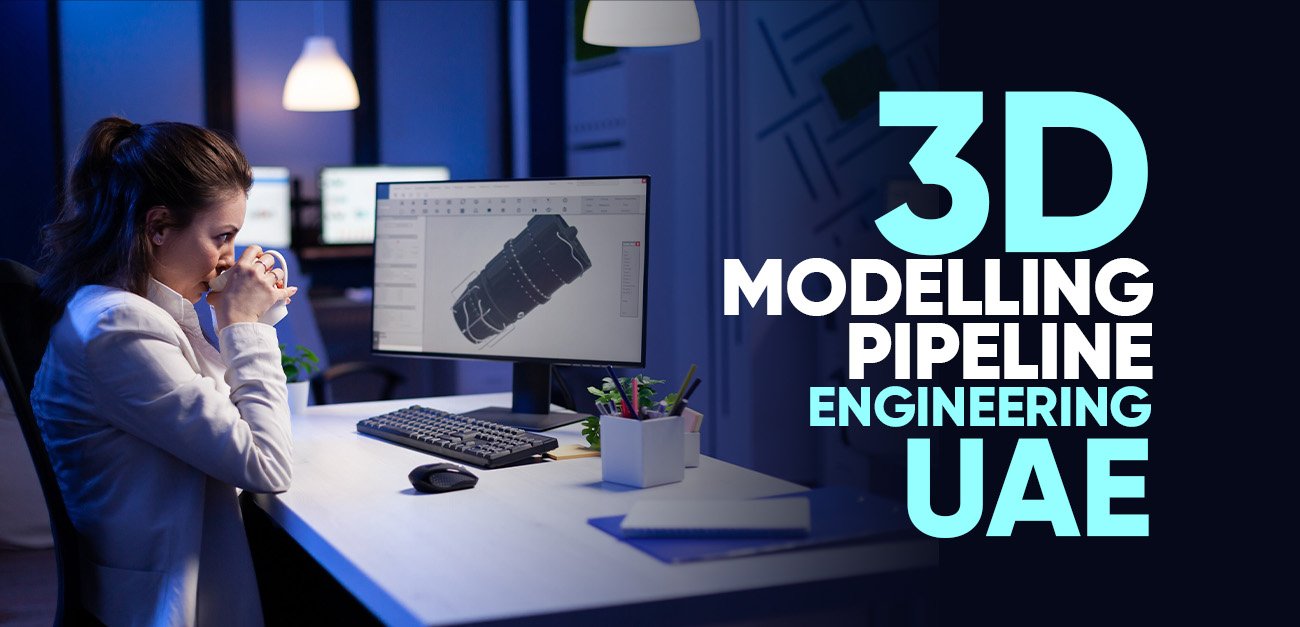
In 2026, 3D plant design — using platforms like AVEVA E3D, Hexagon Smart 3D, or PDMS — is effectively the baseline expectation for detailed engineering on any significant UAE oil and gas project. Major operators including ADNOC and ENOC increasingly specify 3D model deliverables in their engineering contractor requirements. EPC contractors routinely require 3D models as part of their detailed engineering packages.
More importantly, 3D modelling is not just a client requirement — it is an engineering quality tool that directly reduces project cost and schedule risk in ways that 2D drawing-based engineering simply cannot match.
Why 3D Modelling Matters — The Engineering Case
Clash Detection The most immediate and quantifiable benefit of 3D plant design is automated clash detection — the ability to identify physical conflicts between pipes, equipment, structures, electrical cable trays, and HVAC systems before construction begins.
In a 2D drawing environment, clashes are discovered in the field during construction. In a 3D model, clash detection is automated: the software identifies where a pipe route conflicts with a structural steel member, where an equipment nozzle alignment doesn’t match the connected piping, or where a maintenance access requirement is physically blocked by an adjacent system.
The cost of resolving a clash in a 3D model is a few hours of designer time. The cost of resolving the same clash in the field — with materials already fabricated, equipment already installed, and construction crews standing by — is orders of magnitude higher. Industry data consistently shows that comprehensive 3D modelling reduces field design changes by 30–50% on complex projects.
Procurement Accuracy A 3D plant model is the most accurate source of material take-off (MTO) data. Pipe lengths, fitting quantities, valve positions, equipment nozzle specifications, and structural steel quantities extracted from a 3D model are significantly more accurate than those estimated from 2D drawings. For PetroSpan’s procurement management activities, 3D model-extracted MTOs are the foundation of accurate material procurement — reducing the over-procurement waste and under-procurement shortages that plague projects working from 2D take-offs.
Construction Sequencing and Planning 3D models can be used for construction simulation — modelling the sequence in which equipment and piping will be installed to identify access conflicts, lift studies for heavy lifts, and scaffolding requirements. This level of pre-construction planning significantly reduces the construction phase inefficiencies that are frequently blamed on “poor planning” but are actually the downstream consequence of insufficient 3D engineering.
Digital Twin Foundation As discussed in our guide to digital twins in UAE oil and gas, a 3D model is the foundational layer on which an asset digital twin is built. An as-built 3D model, properly attributed with equipment tag data, P&ID references, and inspection point information, is the starting point for a connected operational digital twin. Projects that deliver 3D models with appropriate data attributes are making the operator’s future digital twin programme significantly easier and cheaper to implement.
The Main 3D Design Platforms Used in UAE Projects
| Platform | Developer | Common on UAE Projects? |
| AVEVA E3D Design | AVEVA | Yes — widely used |
| Hexagon Smart 3D | Hexagon | Yes — ADNOC projects |
| PDMS | AVEVA (legacy) | Yes — older projects/retrofits |
| AutoCAD Plant 3D | Autodesk | Yes — smaller projects |
| Navisworks | Autodesk | Yes — clash detection review |
The platform specified on a project is typically determined by the operator or main EPC contractor. Engineering subcontractors need to be able to deliver in the required platform format, or provide model data in compatible exchange formats (PCF, IDF, STEP).
Common 3D Modelling Mistakes on UAE Projects
Starting 3D modelling too late — 3D modelling should begin as soon as the design basis and general arrangement are established. Projects that defer 3D work to save cost in early detailed engineering frequently find that they have created 2D drawing commitments that are expensive to migrate into 3D later.
Under-attributing the model — A 3D model that contains geometry without equipment tags, line numbers, P&ID references, and specification references has limited value beyond clash detection. Fully attributed models — where every element can be traced back to a design document — are significantly more valuable for procurement, construction, and operational use.
Not maintaining as-built status — A 3D model that reflects the design intent but not the as-built configuration of the installed plant has limited integrity and operational value. Maintaining model currency through construction and commissioning is essential if the model is to serve as the basis for future modifications and integrity management.
PetroSpan’s 3D Engineering Capability
PetroSpan’s engineering and technical support services include 3D plant design capability for oil and gas projects across Dubai and the UAE. Our team delivers 3D models that meet operator data requirements, support accurate procurement, and are structured for future digital twin integration.
Contact our team to discuss 3D modelling requirements for your project, or submit an RFQ.
→ Related: Engineering & Technical Support | Procurement Management | Our Projects